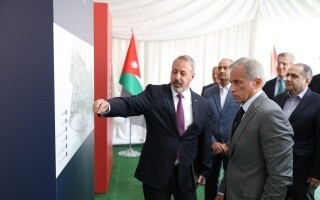
The Jordanian government has announced the launch of the 'Umrah City' project, a new model for sustainable urban development and long-term demographic management in Jordan. The project, to be implemented over 25 years, aims to alleviate demographic pressure on the capital, Amman, and the city of Zarqa. Funding for these projects will come from local and foreign investments. They will be implemented on an area of 40,000 dunums of state land, allocated to the Jordanian Government Investment Fund. According to preliminary studies, the first phase's projects are expected to create thousands of job opportunities, with positive direct impacts on the construction, trade, and tourism sectors, thereby stimulating economic growth. 'Umrah City' will be linked to the Bus Rapid Transit system upon completion of the first phase at the end of 2029, reinforcing its role as a vital center for living, working, and mobility. The project is located on international roads connecting Jordan to Saudi Arabia, Syria, and Iraq, and is 40 kilometers from central Amman and 35 kilometers from Zarqa and Queen Alia International Airport. 10% of the project's land will be allocated to the Jordanian Armed Forces, which will contribute to development and infrastructure work through the Engineering Corps. Additionally, 20,000 dunums of adjacent state land will be designated for housing projects for state employees, retirees, and residents of the Muqarr area through the Public Housing and Urban Development Corporation. The Jordanian Prime Minister emphasized that 'Umrah City' will not be a new capital or an administrative city but is designed to meet future population needs in the kingdom, particularly in Amman and Zarqa, where the population is expected to reach 11 million in 25 years if current growth continues. The project is classified as a 'green city' that relies on the latest environmental and technological technologies, clean energy, and public transport. The first phase includes major investment projects, such as an international exhibition and conference center (2027), a comprehensive sports city featuring an international football stadium and an Olympic village (2029), an ecological park of at least 1,000 dunums, a recreational city (2028), commercial and service areas, an educational city, a technology investment center, and museums and cultural facilities, including an expansion of the Royal Automobile Museum.